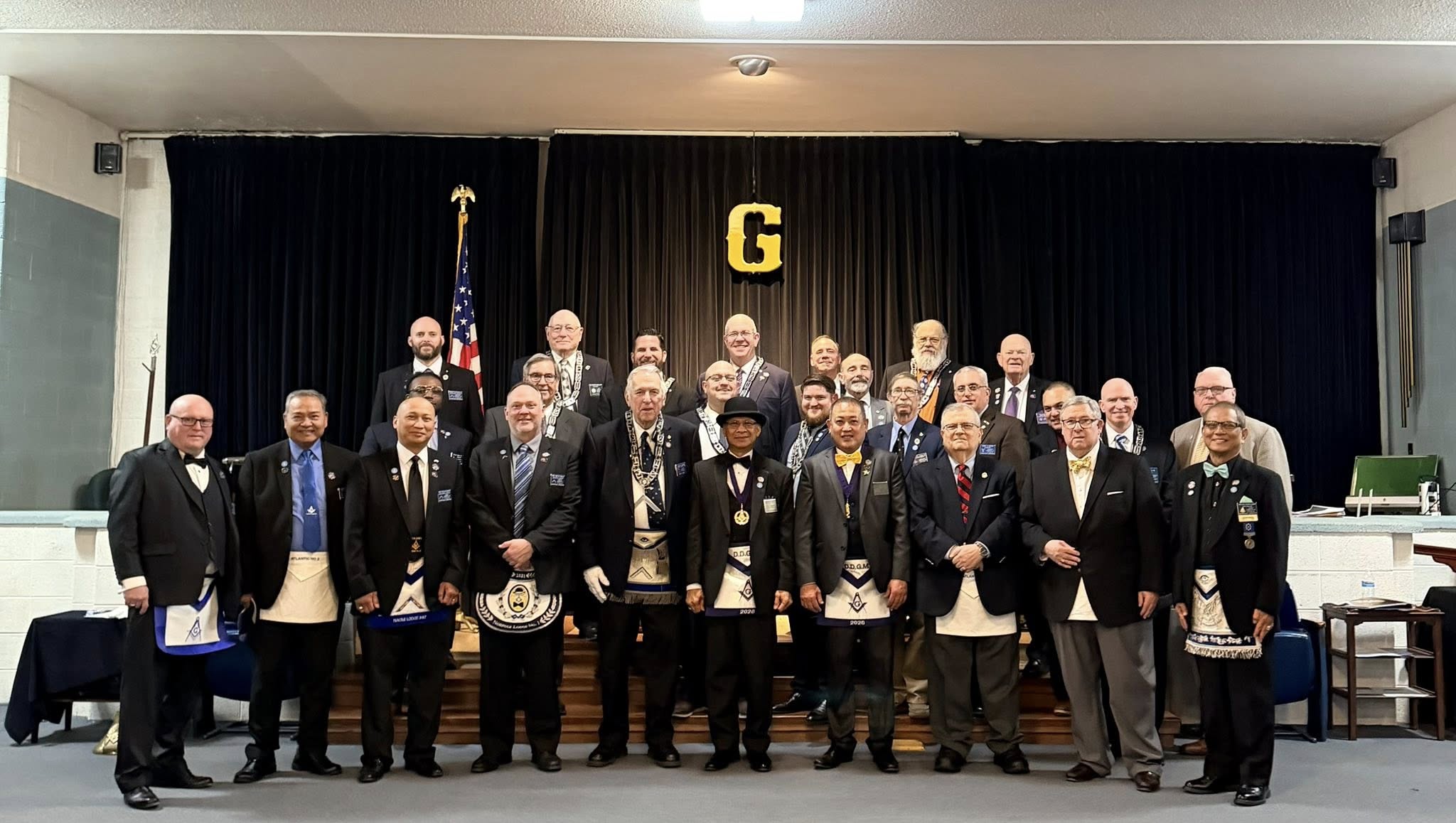
Greetings, Brethren
To the Brethren of Atlantic Lodge No. 2, we extend a warm and fraternal welcome to this first offering of our newsletter.
May these pages serve as a worthy reflection of the light entrusted to our care, as we commemorate and celebrate the storied history of Atlantic Lodge No. 2—its labors, its losses, and its enduring fellowship.
A Distinguished Pillar of Norfolk Masonry
Among the venerable institutions that have shaped Norfolk’s civic and moral landscape, Atlantic Lodge No. 2 stands as a distinguished pillar of Masonic life.
Established in 1854, the Lodge has long served as a gathering place for men devoted to the ancient landmarks of the Craft, meeting in solemn purpose under the bonds of obligation and honor.
Its records preserve a story of perseverance through sorrow, war, and changing times, yet ever guided by the steady aims of brotherhood, charity, and truth.
In every generation, the Lodge has sought to unite men of upright character in the practice of virtue, the relief of distress, and the cultivation of a spirit that outlives the passing hours.
What follows is offered in respectful remembrance—an account of a Lodge whose influence has endured, and whose lights continue to shine with quiet constancy in Norfolk Masonry.
⚒️ Foundation and Early Days
On October 14, 1854, a body of Norfolk Masons assembled in earnest purpose to seek a dispensation for the formation of a new Lodge.
At that meeting, Right Worshipful George L. Upshur solemnly read the dispensation, setting in motion the formal labors of what would become Atlantic Lodge No. 2.
In practical order, the Brethren established a $5 membership fee and fixed the Lodge’s regular communications for the first Saturday of each month, that the work might proceed with consistency and decorum.
Rules of governance were adopted to secure an orderly foundation—defining officers’ duties, guiding proceedings, and preserving the reverent spirit befitting the usages of the Craft.
The first slate of officers was chosen: George L. Upshur, Worshipful Master; James Y. Leigh, Senior Warden; and John Bonsal, Junior Warden.
In an act of fraternal courtesy and lasting consequence, Port Royal Kilwinning Crosse Lodge No. 2 surrendered its charter, that Atlantic might petition for the honored number it bears today.
The charter was granted on December 13, 1854 by the Grand Lodge, signed by Most Worshipful Edmond P. Hunter, thereby placing the Lodge securely within the roll of Virginia Masonry.
💛 The Yellow Fever Tragedy of 1854
In the shadow of the Lodge’s earliest labors came the grievous visitation of yellow fever, which afflicted Norfolk in October 1854 and cast a pall of fear and mourning over the city.
The epidemic carried away a great number of citizens, and its sorrow was felt keenly within the Fraternity as well as beyond it, testing the resolve and compassion of the Brethren.
Most tragically, George L. Upshur—the Lodge’s Worshipful Master, a devoted Mason, and a practicing physician—was taken by death before he could complete his term in the East.
His loss, so near the Lodge’s beginning, stands in the record as a solemn reminder that Atlantic Lodge No. 2 was founded not in ease, but in endurance.
Yet even amid grief, the Lodge’s early story reveals the quiet strength of Masonic fidelity: to meet hardship with steadiness, to honor the fallen, and to continue the work with reverent purpose.
🏆 Distinguished Service Through Challenging Times
Among the Lodge’s most faithful leaders was Samuel P. Moore, who served an extraordinary six years as Worshipful Master, with but one year of interruption in that long tenure.
In seasons when steady hands were needed most, his constancy helped keep the lights burning and the work moving forward with dignity and care.
In recognition of that steadfast service, he was elected an honorary member—a rare mark of gratitude from brethren who knew the weight of what he had carried.
He was also presented a Past Masters Jewel adorned with a diamond, a cherished tribute in the annals of the Lodge and a symbol of service rendered without seeking reward.
Yet the record also bears witness to hard seasons: in 1867 the Lodge endured a year in which no petitions were successfully carried to completion, a quiet trial that tested patience and hope.
From 1883 through 1892, the work was notably light, and communications often proceeded with little outward growth to mark the passing years.
The low point came in 1886, when membership had fallen to only 65 brethren, a sobering figure for a Lodge of such early prominence.
This decline was not solely from neglect, but largely from expansion—brethren departing to establish new lights in Norfolk Masonry: Owens Lodge No. 164, Berkley Lodge No. 167, Elizabeth Lodge No. 34, and Corinthian Lodge No. 266.
In a testament to Atlantic Lodge No. 2’s formative influence, the first Worshipful Masters of these Lodges were drawn from the membership of Atlantic Lodge No. 2, proving that even in lean years, it was still planting strong foundations for the Craft throughout the region.
🤝 Brotherhood Beyond Conflict
During the dark years of civil strife, Atlantic Lodge No. 2 held fast to the ancient lesson that the tie of brotherhood may outlast the passions of the hour.
From April 3–8, 1864, the Lodge remained “at refreshment”—not for idleness, but to provide a safe and proper place for visiting Masonic Federal Soldiers to meet in peace during wartime.
In that quiet act—opening a door when the world was closing ranks—the Lodge affirmed that Masons are bound first by honor and the obligations of the Craft.
It was a brave kind of hospitality: not loud, not political, but deeply human, offering sanctuary where the only passwords were courtesy and brotherly regard.
Another narrative, equally moving, begins with an unidentified man found deceased from a self-inflicted wound aboard a vessel traveling from New York to Norfolk.
Upon examination, markings were discovered—Masonic emblems and Knights Templar tattoos—silent witnesses that the departed was a brother of the Fraternity.
With dignity and haste, Atlantic Lodge No. 2 and Grice Commandery arranged a proper burial in the Lodge’s cemetery lot, refusing to allow a Mason to pass into obscurity without honor.
Persistent inquiry suggested his identity as Brother Charles L. Whitman of Vermont, and in time his brother-in-law came forward to claim him and return him to rest beside his wife.
The body was respectfully exhumed, and the family reimbursed the Lodge for its expenses—an act of gratitude acknowledging mercy shown to a stranger.
In enduring thanks, a white marble clock was donated, now kept in the Masonic Temple library on Granby Street, where it stands as a quiet memorial to charity rendered without condition.
✨ Remarkable Communications
The Lodge’s chronicles preserve occasions of uncommon splendor—nights when the labors of the Craft drew brethren from far beyond Norfolk’s bounds and left a lasting glow upon the record.
On November 9, 1900, a called communication was convened to raise Brother Fellowcraft A. B. Toppins, with all officers present and the Lodge room filled to capacity.
No fewer than 300 members and visitors attended, traveling from across the United States, from Canada, and even from two foreign countries—an assembly remarkable for its breadth and spirit.
The degree was conferred by a team in full regalia, composed of skilled brethren from various visiting Lodges, lending the work an uncommon dignity and precision.
Even more singular was the called communication of June 22, 1932, held to raise Brother Fellowcraft John D. Campbell Rockefeller.
For the first section, the officers appeared in colonial costumes, evoking the atmosphere of early American Masonry and turning the evening into a living tableau of heritage.
For the second, they returned to customary regalia, affirming that beneath every flourish of pageantry stood the steady backbone of tradition.
So great was the expected attendance that, by special dispensation, the communication was held not in the Lodge room but at the Wells Theater.
The official count recorded 12 officers, 190 members, and 1,000 guests—an assembly of 1,202 souls witnessing the ceremony with respectful attention and unmistakable awe.
On that historic night, Most Worshipful H. B. Green, Grand Master, delivered the lecture and charge to the newly raised Master Mason, sealing the event with the authority of the Grand East.
To host such a gathering with order, reverence, and warmth required more than planning—it required the practiced harmony of brethren who understood both the letter and the spirit of the work.
These communications, rare in any generation, proclaimed Atlantic Lodge No. 2 as a center of living Masonry—capable at once of exact ritual and generous hospitality.
They remain, even now, bright touchstones in the Lodge’s story, reminding every reader that the past is not merely remembered here—it is honored with pride and carried forward with care.
🏛️ Community Service
The Lodge’s public spirit was plainly seen in 1894, when Atlantic Lodge participated in laying the cornerstone of Epworth Church.
The ceremony drew a crowd of more than 1,000 people, and its significance was such that the event was observed and recorded by the press.
In that open-air assembly, the Lodge’s solemn forms were offered not for spectacle, but as a visible pledge of fidelity to faith, community, and the common good.
Such moments remind us that the Craft’s work is not confined to the Lodge room, but extends outward in steady service to the place we call home.
👑 Grand Masters from Atlantic Lodge
Few honors speak more clearly of a Lodge’s influence than the elevation of its brethren to the governance of the Craft in Virginia.
Atlantic Lodge No. 2 has contributed three Masons to the high office of Grand Master of Masons in Virginia, each bearing the responsibilities of the Grand East with distinction.
Their names remain inseparable from the Lodge’s legacy of leadership and service within the Commonwealth.
| Name | Year | Title |
| Most Worshipful Powhatan B. Starke | 1855 | Grand Master of Masons in Virginia |
| Most Worshipful Thomas F. Owens | 1869 | Grand Master of Masons in Virginia |
| Most Worshipful T. Penn Coleman | 1946 | Grand Master of Masons in Virginia |
These brethren, rising from the Lodge’s own fellowship, reflect the trust Atlantic Lodge inspired throughout Virginia Masonry.
Their example stands as a dignified charge to every generation: to lead with humility, to serve with steadfastness, and to guard the honor of the Craft.
Norfolk, VA • Historical Newsletter Edition (1854–1946 Highlights)
Introduction
Among the venerable institutions that have shaped Norfolk’s civic and moral landscape, Atlantic Lodge No. 2 stands as a distinguished pillar of Masonic life.
Established in the mid-nineteenth century and tracing its formal beginnings to 1854, the Lodge has long served as a gathering place for men devoted to the ancient landmarks of the Craft.
Its records preserve a story of perseverance through sorrow, war, and changing times—yet always with the steady aim of brotherhood, charity, and truth.
What follows is an account, written in a spirit of respectful remembrance, of the Lodge’s enduring significance in Norfolk’s Masonic history.
A Living Charge to the Future
Across the span of generations, Atlantic Lodge No. 2 has endured as both guardian and exemplar of the Craft’s timeless teachings, carrying forward a heritage earned through faithful labor.
Through trial and triumph alike, it has held fast to the principles of brotherhood, charity, and service, offering relief to the distressed and fellowship to the worthy.
Its story reminds us that the Lodge is more than a meeting place—it is a school of character, a refuge for the weary, and a quiet force for good within the community.
Each name in the minutes, each station filled, and each act of mercy offered in silence becomes part of a chain that links yesterday’s obligations to today’s opportunities.
So long as its lights continue to shine in Norfolk, the Lodge’s history will remain not merely a record of the past, but a living charge to the present and the future.
With gratitude for those who came before, we look ahead together—Brethren of Atlantic Lodge No. 2 carrying forward a legacy of 170 years.
May we continue building upon this noble foundation with steady hands and willing hearts, that the next generation may inherit the same light, strengthened by our care.
So Mote It Be